

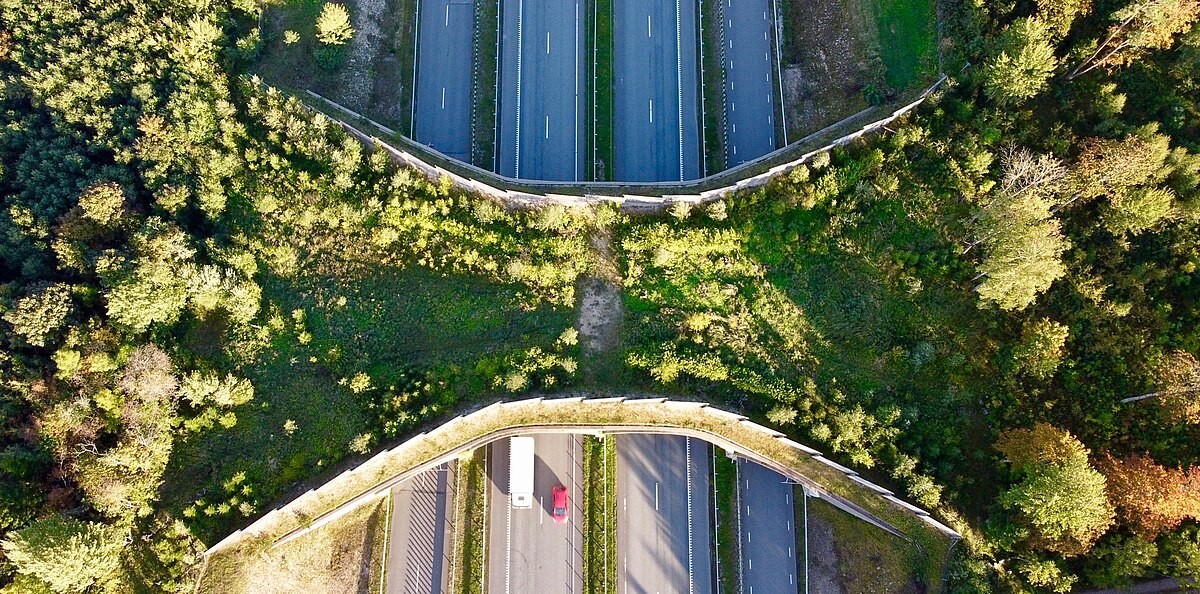
A Wildlife Crossing
Why Wildlife Crossings Matter
Roads can cause major problems for wildlife, and not just from the danger of being truck by vehicles. With busy enough traffic, wildlife may avoid crossing at all, causing habitat fragmentation. Habitat fragmentation is when the natural paths and territories of a living creature is broken up. This limits the area animals can forage, can limit mating options, and can completely disrupt migration patterns. Due to this, habitat fragmentation is showing to have world-wide consequences. [1]
In order to stitch habitats back together, wildlife overpasses, underpasses/tunnels, and viaducts are all used. They not only protect the wildlife, but also help drivers and passengers by limiting the chance of a collision with an animal. Considering roads are the biggest source of human-caused wildlife death in Canada’s national parks [2] , a change can make a big impact.
Proof They Work
Wildlife crossings are not a new idea, so some of our oldest crossings have provided many years of data, showing their worth.
“In 2012, eleven species of large mammals have been recorded using wildlife crossings more than 150,000 times since 1996. This includes grizzly and black bears, wolves, coyotes, cougars, moose, elk, deer, bighorn sheep, and more recently wolverine and lynx.” Parks Canada
When paired with fences to keep animals off the roads and help encourage them to use the crossings, areas can see a reduction in animal-vehicle collisions by more than 80%, and that number jumps to a reduction of 96% for just elk and deer. [4]
What Wildlife Crossings Look Like
There are a wide range of different crossings that might be built for animals. Some are large overpasses that span over roads and are covered with greenery to make them seem more like hills. Others are large tunnels that pass under the roads, and some are barely wider than a basket ball or baseball, and are used for our smallest critters. An example of one of these small paths is in Waterton Lakes National Park (Canada) where care was taken to ensure Salamanders have a safe path. [5]
Typically, overpasses work better than underpasses for most wildlife, since not all wildlife is comfortable traversing into a dark tunnel which is often loud with traffic vibrations. In comparison, the overpasses are typically made with soil, grass, and trees, to feel like a hill for wildlife.
Where We Also Need More
As cities continue to spread outward, one place more care in creating these would be within cities themselves. Typically, they are only found in wild spaces, but they make a big impact in cities as well.
You must log in or # to comment.