
I currently keep track of which model kits, brick building sets, and painting miniatures that I own and whether I have made progress on them in a Google Sheet. As part of my attempt to degoogle, I am looking into various alternatives.
My current preferences for an alternative are:
- Accessible online
- Can be edited online/in-browser (potentially through some frontend)
- Loads relatively quickly/efficiently
- Hardware is an issue here; my server computer is quite low end
- Accessible on an Android device (does not have to be able to be edited on mobile)
- Preferably can display linked images, whether on Nextcloud’s filesystem or through hyperlinks
One of the alternatives I’ve already tried is the Nexcloud Office plugin for my existing Nextcloud server using Collabora Online as a backend. In addition to it loading quite slowly, I had issues editing any files created with the plugin, and after tinkering with it for a while I decided to put that solution aside. This was several months ago.
Another alternative I have considered is coverting this sheet into a database. I do not have much experience with databases (pretty much just creating one in MariaDB for Nextcloud), but from what I know about them this seems like a good use case for one. I do not know what would be best as a frontend; phpMyAdmin? DBeaver?
Any suggestions? If all else fails, I’ll just keep an .ods document on Nexcloud and install LibreOffice Viewer on my phone, but I would prefer not to have to download and upload the .ods through Nextcloud every time I want to update my inventory (this is primarily an issue when I update it at work).
This is what I currently use:
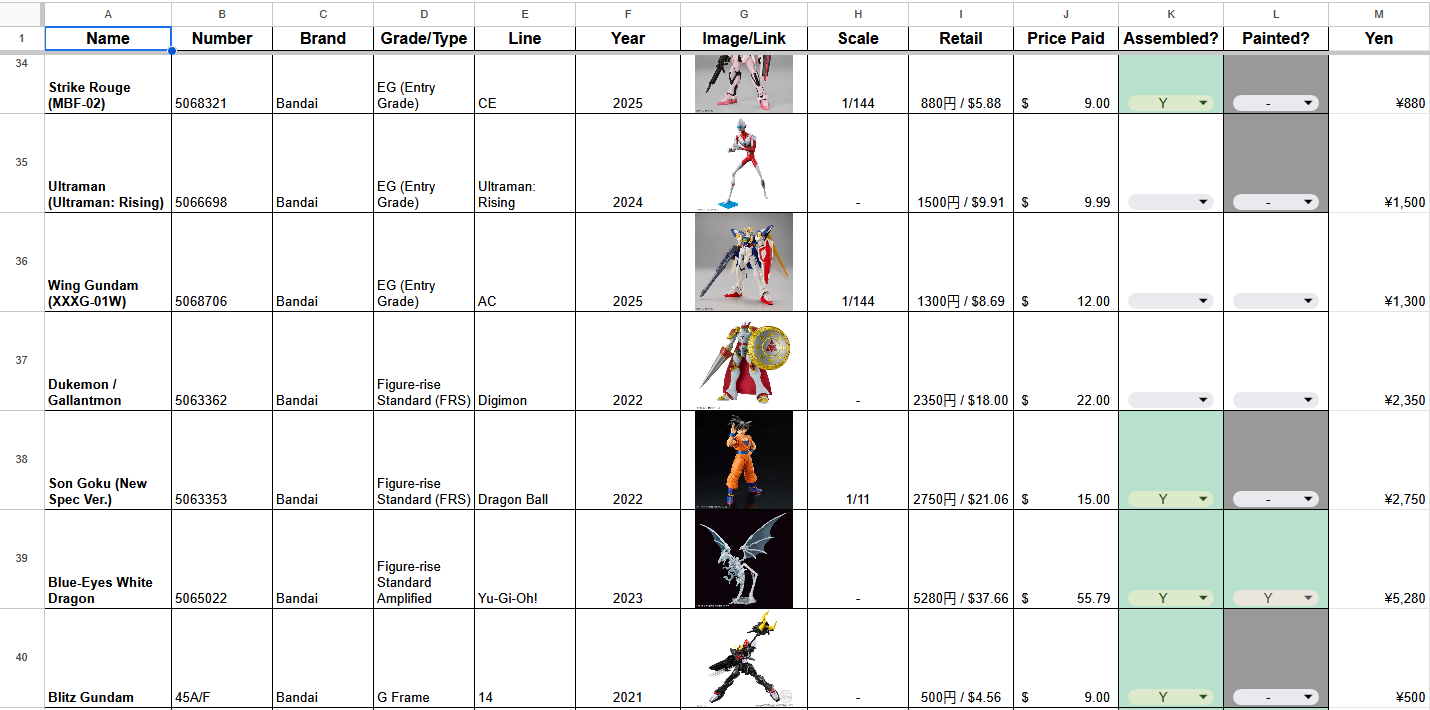
Markdown table with data type guesses if image does not load
| Name | Number | Brand | Grade/Type | Line | Year | Image/Link | Scale | Retail | Price Paid | Assembled? | Painted | Yen |
|---|---|---|---|---|---|---|---|---|---|---|---|---|
| Gundam Barbatos Lupus (ASW-G-08) | 5055446 | Bandai | HG (High Grade) | I-BO | 2016 | [Formula1] | 1/144 | [Formula2]/[USD Retail] | $10.19 | Y/N/'- | Y/N/'- | 1000 |
| [TINYTEXT] | [VARCHAR] | [TINYTEXT] | [TINYTEXT] | [TINYTEXT] | [YEAR] | [TEXT] | [FLOAT]/[SMALLINT]/[TINYTEXT] | [DECIMAL] | [DECIMAL] | [BOOLEAN] | [BOOLEAN] | [SMALLINT] |
There are only a few formulae used:
- One to both link to a webpage for that kit and display an image of it; these could be easily separated into two fields
Formula 1:=HYPERLINK("https://bandai-hobby.net/item/5886/",IMAGE("https://bandai-hobby.net/images/157_5886_s_5pwg9tvxlm5v4gwrz49ly8ry3j8e.jpg")) - One to convert the Japanese retail of a product (in the
Yencolumn) to equivalent USD in the release year (could easily be replaced with a manual conversion or a researched US retail)
Formula 2:=M36&"円 / $"&TEXT(M36*VLOOKUP(F36,'Currency Rates'!$A$2:$B$52,2,FALSE),"#,##0.00") - And one to grab the current average conversion rate for the year (again, could be replaced with a quick search)
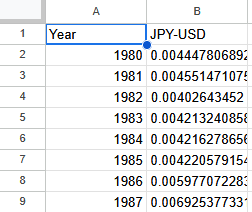
Formula 3:=QUERY(GOOGLEFINANCE("CURRENCY:JPYUSD","price",DATE(A47,1,1),IF(DATE(A47,12,31)-TODAY()>0,TODAY(),DATE(A47,12,31)),"DAILY"),"select avg(Col2) where Col1 is not null label avg(Col2)''",1)
This last formula is used on a conversion sheet referenced in Formula 2, which looks like this:
I appreciate any help.
I think you could replicate this in silverbullet.md. One file per entry, with frontmatter for the fields (you can create a template for that) and then one file with a query table as overview. Not sure if query tables display images, though.
Edit: Should work with image path in frontmatter and a query and a render template.
Thank you for the suggestion. I will look into it. It seems like I will need more than a brief glance at the readme to figure out how it works, but it seems like installation is relatively simple.
Sure thing. It’s a different approach but could work well for this. Plus, you might end up with a knowledge management system on your hands as an added bonus.