If the goal was to keep Kamala out of the office, the goal was achieved. If the goal was to keep the shadiest asshole out, it failed in a manner that would be laughable if it wasn’t so horrible. If the goal was to not vote for shady people, well, how did that solve the problem of shady people in power? That isn’t whataboutism, it is merely pointing out facts.
“If Kamala had done this…” - not a personal attack.
“If you (which is a plural, by the way) had done this…” - clearly a personal attack.
But please, assume the you was singular. How are those two statements different?
I’m not a fan of false dichotomies, but FPTP devolves into a dichotomy. Pretending it doesn’t, or that even inaction has no bearing on the outcome, is just wishful thinking. There were two choices to be had, and every American who had the option made a choice, whether through action or inaction. Sure, Kamala could have made a statement to not support genocide. Maybe she would even have won if she had done so. But at the end of the day, a choice was still made, by each and every American with the option to vote.
You are arguing with someone who is lying to you. You will never “win” this argument or convince them because everything that they say is a lie with a complete different agenda than what they say.
Whether they are a bot or a person, paid or freelance psychopath, they are here to disenfranchise voters and convince young people to throw away their vote on nonsense, or that their vote is essentially meaningless and they shouldn’t bother.
I was actually trying to be generous in saying that you had a plan and are doing a psyop… I mean it’s painfully obvious that you don’t give a shit about your own arguments, and you are obviously not dumb as most of the maga crowd. So if it is not a psyop, then it’s some kind of masterbatory thing where you get off on upsetting people or being yelled at and insulted… At that’s just gross… Not to cast shade on your kink, you do you king, but gross that you would involve other people in your kink without their knowledge or consent. I mean it makes you nothing more than a public masturbator, or some flasher waving their genitals at random people.
I’m not a fan of false dichotomies, but FPTP devolves into a dichotomy
This is just factually false, and it’s as simple as looking at the vote results to acknowledge. You can want to present it as a binary, but in reality, voters have many options beyond vote R or vote D.
I don’t really know how else to address this for you. Maybe you saw or heard some NPR or wall street journal clip about strategic voting and that was formative for your understanding of how elections work. Regardless, it was wrong because in the real world, when we run real elections, not hypothetical ones, voters choose to do or not do a wide range of different things.
That’s not wishful thinking. That’s looking at results from real elections. You aren’t addressing reality, you are moralizing about how you wish things were, but aren’t.
The point is that your moralizing and insistence doesn’t have any bearing on how voters actually behave. You have to base your strategy on how things actually are, in the real world, backed up with receipts from real elections.
Strategic voting as strategy is irrelevant if voters don’t actually behave that way. You might claim then that American voters are stupid voters who vote against their own their own interests because they don’t abide by your approach. Ok fine. Then they are that way. But then you also must acknowledge that your outline if how to win an election is flawed because American voters don’t behave that way.
You want voters to vote better but they don’t. You want voters to be smarter but they aren’t. If you are advocating a strategy that requires voters to be both smarter and better than they are, what’s the likelihood of it succeeding?
You can’t “fix” voter behavior. You can only adapt the strategies you rely on to accommodate real voters. Advocating strategic voting doesn’t do this and lives in the realm of puritanical moralizing.
Sure, Kamala could have made a statement to not support genocide. Maybe she would even have won if she had done so.
That’s it. It’s all that matters. There was one path to winning the election and it was to get the candidate to change their policy in the most important issue of the election. There was no other path to victory for the Dems.
But at the end of the day, a choice was still made, by each and every American with the option to vote.
We agree that voters don’t meet your moral standard. But if you are advocating for strategies that depend on voters being different than they are, its your fault when those strategies fail.
“If Kamala had done this…” - not a personal attack.
Are you Kamala Harris? If you are, Mamala, if I can call you Mamala, why didn’t you change your stance on Gaza so that you could win the election?
“If you (which is a plural, by the way) had done this…” - clearly a personal attack.
But please, assume the you was singular. How are those two statements different
I apologize for interpretating the word “you” to mean the word “you”. If you mean to speak of “they”, you can use language like “voters”, or the “electorate”, or the “unwashed masses”, whatever you prefer. But when you use the word “you” in response to something I say, there is no other way for me to interpret that other than by assuming you are directing the statement at me.
Sure, Kamala could have made a statement to not support genocide. Maybe she would even have won if she had done so.
That’s it. It’s all that matters. There was one path to winning the election and it was to get the candidate to change their policy in the most important issue of the election. There was no other path to victory for the Dems.
If that was all that mattered, people would have voted for less genocide, rather than refusing to vote so they could say they didn’t vote for genocide, when in fact they said they were fine with whatever the rest of the voting public went with, which was inevitably some degree of genocide. Certainly, voting for Trump in protest wasn’t a vote against genocide.
I apologize for interpretating the word “you” to mean the word “you”. If you mean to speak of “they”, you can use language like “voters”, or the “electorate”, or the “unwashed masses”, whatever you prefer. But when you use the word “you” in response to something I say, there is no other way for me to interpret that other than by assuming you are directing the statement at me.
I’m sorry that your grasp of the English language is lacking. In that case, you, which is always syntactically plural, was used to refer to a singular individual.
You’re just as wrong either way. If you’re talking about the general public, then your demanding the people change their views to line up with those of a politician, rather than the other way around. Not only is that antithetical the the very idea of democracy, it’s also just impractical. Isn’t it much easier to get one person to change their views instead of millions? Why are you focusing on the millions then?
It’s because you’re looking at things from entirely the wrong framework - one that has internalized the supposed “superiority” of the ruling class and asks nothing from them, instead trying to discipline the public to serve the elites unquestioningly and unconditionally. Your worldview is completely upside down.


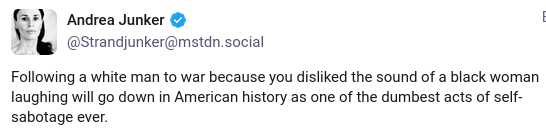
Holy whataboutism. Nothing absolves here of the shitty things she has done. The lesser evil ideology is why Trump is the current US president.
If the goal was to keep Kamala out of the office, the goal was achieved. If the goal was to keep the shadiest asshole out, it failed in a manner that would be laughable if it wasn’t so horrible. If the goal was to not vote for shady people, well, how did that solve the problem of shady people in power? That isn’t whataboutism, it is merely pointing out facts.
There was one way to get Harris into office: she had to change her stance on genocide.
There was one way to keep Trump out of office, and it wasn’t sitting on your hands.
See how you it switched to a personal attack about what one individual dies? That’s form of misdirection.
“If Kamala had done this…” - not a personal attack.
“If you (which is a plural, by the way) had done this…” - clearly a personal attack.
But please, assume the you was singular. How are those two statements different?
I’m not a fan of false dichotomies, but FPTP devolves into a dichotomy. Pretending it doesn’t, or that even inaction has no bearing on the outcome, is just wishful thinking. There were two choices to be had, and every American who had the option made a choice, whether through action or inaction. Sure, Kamala could have made a statement to not support genocide. Maybe she would even have won if she had done so. But at the end of the day, a choice was still made, by each and every American with the option to vote.
You are arguing with someone who is lying to you. You will never “win” this argument or convince them because everything that they say is a lie with a complete different agenda than what they say.
Whether they are a bot or a person, paid or freelance psychopath, they are here to disenfranchise voters and convince young people to throw away their vote on nonsense, or that their vote is essentially meaningless and they shouldn’t bother.
Yeah. Everything that you don’t like to hear is a psyop, sure buddy.
I was actually trying to be generous in saying that you had a plan and are doing a psyop… I mean it’s painfully obvious that you don’t give a shit about your own arguments, and you are obviously not dumb as most of the maga crowd. So if it is not a psyop, then it’s some kind of masterbatory thing where you get off on upsetting people or being yelled at and insulted… At that’s just gross… Not to cast shade on your kink, you do you king, but gross that you would involve other people in your kink without their knowledge or consent. I mean it makes you nothing more than a public masturbator, or some flasher waving their genitals at random people.
This is just factually false, and it’s as simple as looking at the vote results to acknowledge. You can want to present it as a binary, but in reality, voters have many options beyond vote R or vote D.
I don’t really know how else to address this for you. Maybe you saw or heard some NPR or wall street journal clip about strategic voting and that was formative for your understanding of how elections work. Regardless, it was wrong because in the real world, when we run real elections, not hypothetical ones, voters choose to do or not do a wide range of different things.
That’s not wishful thinking. That’s looking at results from real elections. You aren’t addressing reality, you are moralizing about how you wish things were, but aren’t.
The point is that your moralizing and insistence doesn’t have any bearing on how voters actually behave. You have to base your strategy on how things actually are, in the real world, backed up with receipts from real elections.
Strategic voting as strategy is irrelevant if voters don’t actually behave that way. You might claim then that American voters are stupid voters who vote against their own their own interests because they don’t abide by your approach. Ok fine. Then they are that way. But then you also must acknowledge that your outline if how to win an election is flawed because American voters don’t behave that way.
You want voters to vote better but they don’t. You want voters to be smarter but they aren’t. If you are advocating a strategy that requires voters to be both smarter and better than they are, what’s the likelihood of it succeeding?
You can’t “fix” voter behavior. You can only adapt the strategies you rely on to accommodate real voters. Advocating strategic voting doesn’t do this and lives in the realm of puritanical moralizing.
That’s it. It’s all that matters. There was one path to winning the election and it was to get the candidate to change their policy in the most important issue of the election. There was no other path to victory for the Dems.
We agree that voters don’t meet your moral standard. But if you are advocating for strategies that depend on voters being different than they are, its your fault when those strategies fail.
Are you Kamala Harris? If you are, Mamala, if I can call you Mamala, why didn’t you change your stance on Gaza so that you could win the election?
I apologize for interpretating the word “you” to mean the word “you”. If you mean to speak of “they”, you can use language like “voters”, or the “electorate”, or the “unwashed masses”, whatever you prefer. But when you use the word “you” in response to something I say, there is no other way for me to interpret that other than by assuming you are directing the statement at me.
If that was all that mattered, people would have voted for less genocide, rather than refusing to vote so they could say they didn’t vote for genocide, when in fact they said they were fine with whatever the rest of the voting public went with, which was inevitably some degree of genocide. Certainly, voting for Trump in protest wasn’t a vote against genocide.
I’m sorry that your grasp of the English language is lacking. In that case, you, which is always syntactically plural, was used to refer to a singular individual.
Because one of those is a public figure who’s supposed to be representing the will of the people and the other is just some random person.
Assuming I was using you in the singular. After that, the public is on the same level as a public figure, in my opinion.
You’re just as wrong either way. If you’re talking about the general public, then your demanding the people change their views to line up with those of a politician, rather than the other way around. Not only is that antithetical the the very idea of democracy, it’s also just impractical. Isn’t it much easier to get one person to change their views instead of millions? Why are you focusing on the millions then?
It’s because you’re looking at things from entirely the wrong framework - one that has internalized the supposed “superiority” of the ruling class and asks nothing from them, instead trying to discipline the public to serve the elites unquestioningly and unconditionally. Your worldview is completely upside down.