Don’t even need calculus. You move the hand 1/2 of the way in 1/2 of the total time. Then 1/4 of the way in 1/4th of the total time… They just forgot to think about how the intervals of time those steps take are proportional to the size of the step.
Let’s put it this way: you move your hand 1m in 1s. Looking at it like Zeno, there are infinite space-steps that total in 1m moved. And there are infinite time-steps that total in 1s. If there is no problem in having infinite space-steps covering a finite distance, what’s the problem with having infinite time-steps covering a finite time?
It’s more fundamentally philosophic than calculus, that’s why I said it’s unnecessary. You don’t need to know you can sum infinite “infinitesimal” parts and get a finite quantity, or how to do it. It’s just a simple reasoning to see there’s no paradox (in the “it’s impossible” sense) at all.


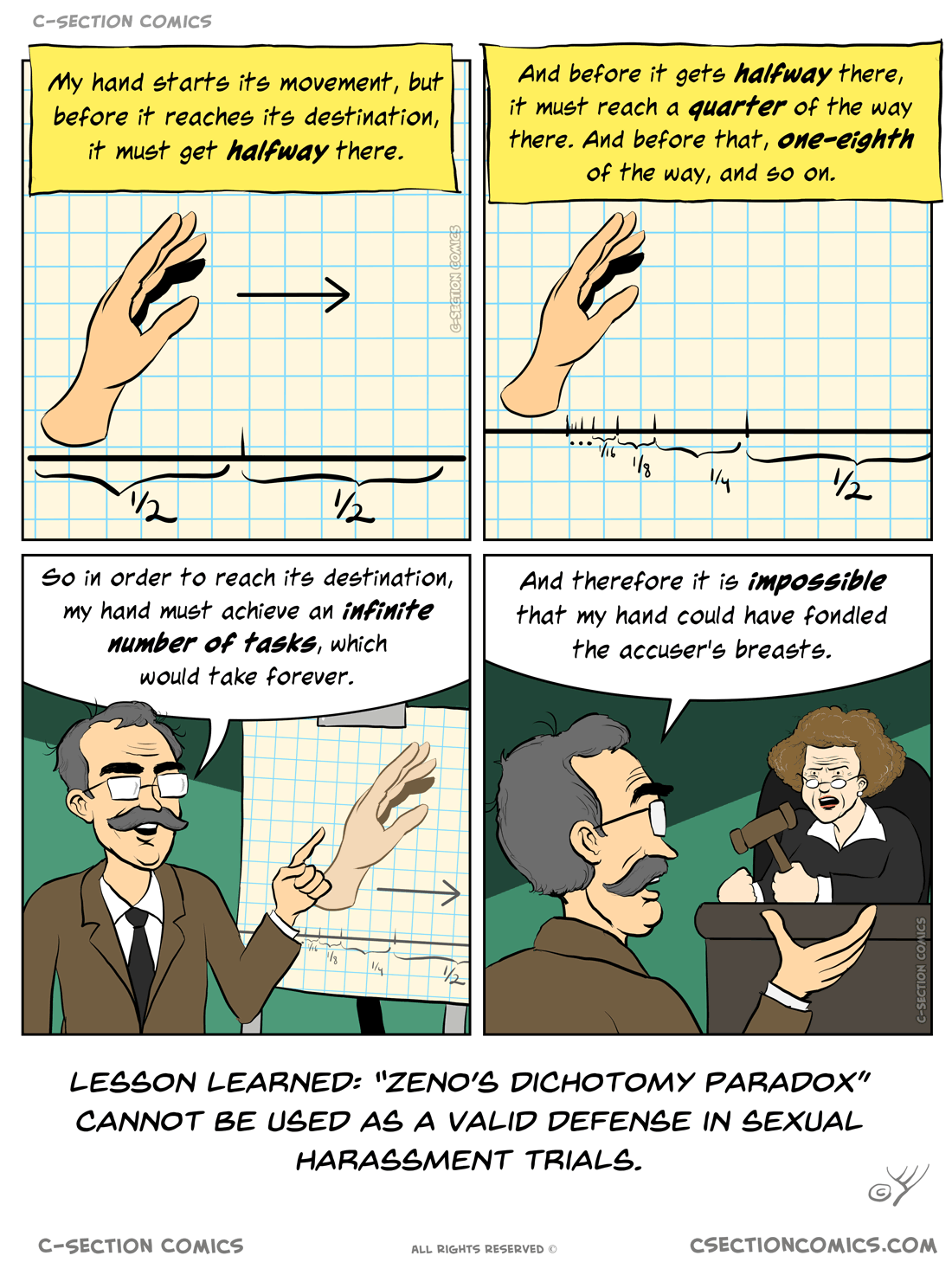
Don’t even need calculus. You move the hand 1/2 of the way in 1/2 of the total time. Then 1/4 of the way in 1/4th of the total time… They just forgot to think about how the intervals of time those steps take are proportional to the size of the step.
But the amount of time is never zero for any step, and there are infinite steps.
The amount of time does, however, approach zero, so calculus solves the problem.
Let’s put it this way: you move your hand 1m in 1s. Looking at it like Zeno, there are infinite space-steps that total in 1m moved. And there are infinite time-steps that total in 1s. If there is no problem in having infinite space-steps covering a finite distance, what’s the problem with having infinite time-steps covering a finite time?
It’s more fundamentally philosophic than calculus, that’s why I said it’s unnecessary. You don’t need to know you can sum infinite “infinitesimal” parts and get a finite quantity, or how to do it. It’s just a simple reasoning to see there’s no paradox (in the “it’s impossible” sense) at all.