
- cross-posted to:
- roughromanmemes@piefed.social
- cross-posted to:
- roughromanmemes@piefed.social
You must log in or # to comment.
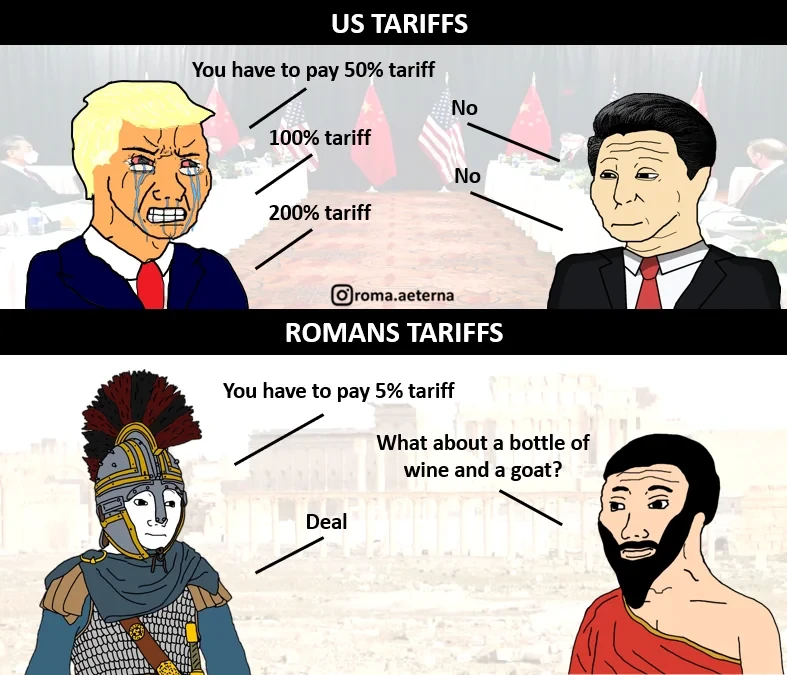
Explanation: Roman tariffs actually varied - the standard transport tax within the Empire, the portaria, was 1/40th (2.5%), payable once at a local administrative center (typically a large city). There was a special import tax placed on the East, though, the tetarte, which was 1/4 (25%), mostly to take advantage of the high-value spices, silks, and incense that poured over the Eastern borders. By some estimates, the tetarte provided up to a third of the Empire’s tax revenues! Which demonstrates both the value of the luxuries being imported, and the relatively low costs taken by the central government of the Empire.
How did the central government do so much with so little revenue taken in? Or was a lot of the governmental progress of the day just city governments?
Yes, part of it was that much of the Principate’s functioning - the era of the Roman Empire we generally think of - was delegated to city governments. In general, the Roman Empire expected a small contribution from city governments in exchange, essentially, for taking care of security and leaving them otherwise largely to their own devices - though the Romans generally preferred to install governments which resembled the republican system of the city of Rome. Road maintenance, when it wasn’t assigned to the military, was often delegated to nearby towns or cities.
There was also a strong sense of euergetism - when cities undertook large projects, instead of increasing taxes, it would sometimes simply be taken up by the local wealthy, either semi-mandatorily (arguments over what duties were mandatory was a constant subject of legal debate), or as part of an implicit social contract of “We poor folk will sing your praises today and not tear you to pieces during the next riot in exchange for your funding of public works.” Mutual aid societies/guilds/proto-unions - collegia - also were known to patronize projects.
Part of it was that the main expense of the Empire - the Roman Legions and Auxilia - doubled as mobile labor forces in peacetime, able to undertake hard labor (mining, construction, road maintenance), security (border patrol, policing), and minor clerical duties (tax-collecting, including tariffs; records-keeping). Very financially efficient to have your soldiers as dual-use employees!
Part of it was that the central government itself had few expenses - other than the military, the largest budget item, there wasn’t much in the way of a dedicated imperial bureaucracy. A relatively small collection of the Emperor’s slaves and freedmen oversaw some of the functioning, but most of them would’ve been paid from the imperial estates (a bizarre hybrid of public and private property), while the formally elected and appointed officials of the Empire were largely self-funding, both themselves and their staffs. The entire imperial apparatus, including the aforementioned officials, numbered probably less than a thousand employees (minus, of course, the military).
trump: “100% tarriff!!”
world: “get fucked”
trump: “50% tarriff!!”
world: “…”
trump: “i JuSt SaVeD yOu 75%”