

3·
6 months agoI use Secure Boot on all my machines but I just use my own keys with Foxboron’s wonderful sbctl utility instead of the hacky shim/MOK method most distributions use.

Keyoxide proof: $argon2id$v=19$m=64,t=512,p=2$/Bxo7QiXHH/MThwxZ1irnA$S8IDyQY5+tRZjnqvqnYcGQ
I use Secure Boot on all my machines but I just use my own keys with Foxboron’s wonderful sbctl utility instead of the hacky shim/MOK method most distributions use.
+1 for uBlue. I did the same for my mother on her laptop and desktop PC for office work. Chose Aurora in this case. Setting system and flatpak updates to automatic means I hopefully never have to look after these systems again as the distro maintainers basically do the maintenance. Setting up Secure Boot with the shim/MOK method and TPM auto-unlocking for full disk encryption using the ujust scripts is a breeze as well.

What actually exists but what I have yet to see implemented in any game I play are those server-side “AI anti-cheat” solutions like from anybrain that basically just analyse the players behavior to fit certain criteria. According to areweanticheatyet.com though there are four games using it already (the most well-known one probably being Lost Ark). In theory ai models can be very efficient and accurate at this (we are not talking about transformer models here like with the current llm craze) but that all depends on how they train a model and what the training data looks like.
What surprised me the most, also in part due to me not really being knowledgeable about software solutions in their respective industries, was the Unreal Engine (the editor that is) and Houdini being available on Linux. Tbf, at least in the vfx department it is apparently more common as most of the high profile software in that industry does have a native Linux version available.
What I appreciated the most though was software like Reaper and Renoise providing a (very good even) Linux-native version when I looked for a new DAW to learn, seeing most software in the audio industry not being very Linux-friendly.

Yes, thank you for mentioning the Strix Halo CPUs from AMD. I had this exact same thought before as well ever since I’ve seen these CPUs come to market. The SoC design is much more similar to the Apple M chips that can provide absurd memory bandwidth as well. I could imagine a cut down/low power version provided by AMDs semi-custom program where Valve would get a unique design again like with the first Steam Deck. Due to the high bandwidth LPDDR5x memory they would wipe the floor with every existing handheld SoC on the market today.
+1 for OVPN. I switched to them from Mullvad for the same reason. They are also one of the more trustworthy VPNs in my book ever since they actually won a court case proving that they actually practise what they advertise.
Matrix is alright with clients like Element (X) and Cinny. But for me it’s rather a (still somewhat lacking) Discord replacement. Maybe at some point with better clients this improves. The protocol already allows for a lot of stuff but most clients don’t implement most functionality (yet).
If you can wait just a little longer I would seriously consider the Framework 12 that is going for pre-order next month and being shipped “mid-2025”.
Of course, this isn’t an option if you need a laptop right now. In that case the current Framework 13 offerings are the best you can get but of course are not as affordable and possibly a bit overkill for a simple browsing machine.

What I’ve played on my Deck over the last months and would consider more of the type of games you listed:
Edit: Formatting

You can install the Zen kernel as it has the ntsync patch merged already and which I personally prefer for a gaming (desktop) system.
But as I understand it we have to still wait for the corresponding wine patch to be merged as well for it to be usable for Windows applications and more so in case of Proton.
According to her pinned Xitter post, Emily left LMG at the end of August already.
To clear my backlog a bit I recently played Little Kitty, Big City, Smushi Come Home and now Paper Trails. Currently more on the ‘cosy train’ of games. I think Little Kitty, Big City was the first game I played on the Deck that implements the Steam Input API.
These are some very good game ideas. :)
The few hours I’ve spent in Wobbledogs, Shenzhen I/O and Another Crab’s Treasure apparently were more significant to Steam than the few hundred hours in Satisfactory and Factorio.
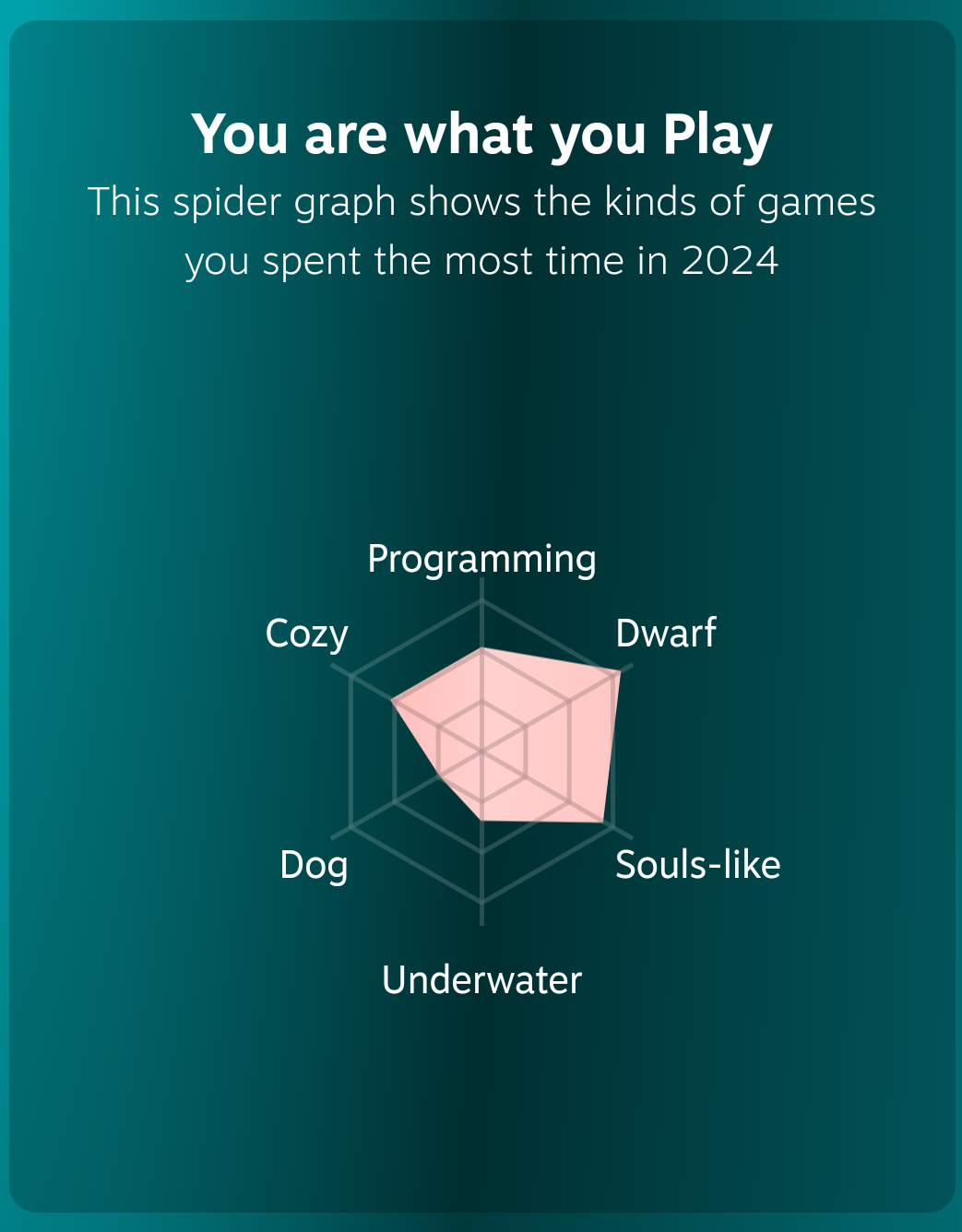
I agree, we need more Dwarf Souls-Likes.
I have that genre listed there too only because I played ~7 hours of Wobbledogs this year.

It’s beyond me why Valve hasn’t yet deleted that page or at least updated it to make it clear that it’s an obsolete version that hasn’t received an update in 8 years.


Well, if you compare it to the state of the Play Store, likely 95% of games wouldn’t be allowed to be published on Steam anyway because they don’t allow advertisement in games (unless it’s for games on Steam itself) and other dark patterns these apps deploy.