I just don’t understand how selling everything they produce increases costs. Are they just charging more for more profits, or is the increased prices funding increased production?
The vast difference in economics between retail and manufacturing don’t make sense to me.
A bigger share of the current factory output is being routed to the tech companies rather than the consumer component shops meaning there’s less to go around. Since there’s less to go around, consumer-facing stores are forced to bid higher to be able to maintain their stock which is then passed on to us plebs
Easy. They always sell the amount they produce. However only when they lower the price. Nobody with a sane mind pays 150 € for 8GB of RAM.
However what if they already sold everything and even future products to someone and have the money already? Well now you have the same demand but no supply. Of course demand falls with increasing prices, but your supply is so limited that you want to reach the sweet spot where someone still pays that much for it and where you still sell everything you have left.
Let’s say I harvest 100 apples a year and my neighbours buy 70 each year I basically only charge as much as it costs me to harvest them so I have a little winnings. Because if not they will buy from someone else.
But now someone buys all the apples he can get. Now I sold 98 apples and my neighbours still want to buy 70. Well at some price they will only want to buy 2.so I charge 500 per apple, because I am greedy.
My micro economics would tell me it’s that the demand curve is shifting upwards, while the supply curve is at best the same, of not going lower (currently), so the intersecting price where they meet goes up. While it may be artificial, more demand on the same supply increases prices typically. Depending on the elasticity of the demand for the product (toys VS household electricity costs for example), the market will bare the increases if it deems it essential.
But those were lessons from 15 years ago, this brave new world of open corruption and greed have probably up ended some of those concepts. The circular fake economy of a half a dozen tech companies can probably only sustain itself for so long, I guess we’ll see how it all pans out

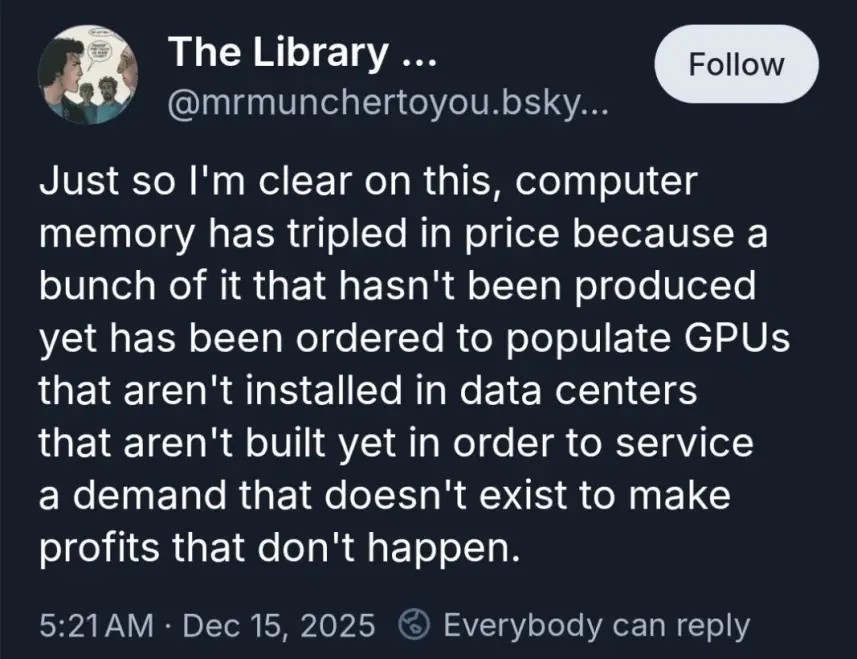
I just don’t understand how selling everything they produce increases costs. Are they just charging more for more profits, or is the increased prices funding increased production?
The vast difference in economics between retail and manufacturing don’t make sense to me.
A bigger share of the current factory output is being routed to the tech companies rather than the consumer component shops meaning there’s less to go around. Since there’s less to go around, consumer-facing stores are forced to bid higher to be able to maintain their stock which is then passed on to us plebs
At that scale it’s kind of like an auction for the capacity to produce the chips (and it’s the DRAM chips, not the finished modules in this case).
So for a DIMM retailer to get enough chips to make a product they need to out bid Nvidia :-(
Easy. They always sell the amount they produce. However only when they lower the price. Nobody with a sane mind pays 150 € for 8GB of RAM.
However what if they already sold everything and even future products to someone and have the money already? Well now you have the same demand but no supply. Of course demand falls with increasing prices, but your supply is so limited that you want to reach the sweet spot where someone still pays that much for it and where you still sell everything you have left.
Let’s say I harvest 100 apples a year and my neighbours buy 70 each year I basically only charge as much as it costs me to harvest them so I have a little winnings. Because if not they will buy from someone else.
But now someone buys all the apples he can get. Now I sold 98 apples and my neighbours still want to buy 70. Well at some price they will only want to buy 2.so I charge 500 per apple, because I am greedy.
My micro economics would tell me it’s that the demand curve is shifting upwards, while the supply curve is at best the same, of not going lower (currently), so the intersecting price where they meet goes up. While it may be artificial, more demand on the same supply increases prices typically. Depending on the elasticity of the demand for the product (toys VS household electricity costs for example), the market will bare the increases if it deems it essential.
But those were lessons from 15 years ago, this brave new world of open corruption and greed have probably up ended some of those concepts. The circular fake economy of a half a dozen tech companies can probably only sustain itself for so long, I guess we’ll see how it all pans out