

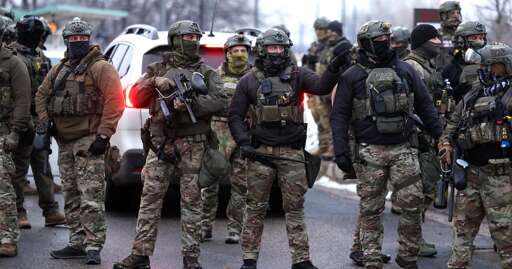
State troopers in Minnesota have arrested and charged a Border Patrol agent with drunk driving after he was found passed out in a car and “covered in vomit.”
Officers discovered Alfredo Mancillas Jr., a 31-year-old Customs and Border Patrol employee from Texas, “slumped over in the driver’s seat” on a St. Paul road in the early hours of Tuesday morning, the Sahan Journal reported.
The CBP guy wasn’t a victim. He was found in the car parked in a no parking area. Not in a bar parking lot trying to sleep it off. He drove to the site of his arrest, ergo the DUI was legit.
Poisoned by antifa, clearly.
One can dream
Don’t care about the guy but this is a great double example of ACAB, where both victim and perpetrator fit the description:
arrested and charged a Border Patrol agent with drunk driving
Mancillas, who had parked
It’s utterly insane to criminalize sleeping in your car while drunk.
He was either sober or drunk when the vehicle was pulled over, so the question becomes, was he parked somewhere reasonable to have a quick drunk? It sounds like he wasn’t, which raises the likelihood that he was drunk when he pulled over, so DUI. That said, I agree that being drunk in a parked vehicle, or even being asleep in a parked vehicle shouldn’t be illegal, but the former is illegal and the latter often is, as well.
I think it’s rather difficult to prove beyond reasonable doubt he pulled over after drinking.
I mean, what can you even use as evidence? Maybe payment records from his bank account to prove he was at a bar or something but I’m not sure a (gross) misdemeanor charge is sufficient for such a warrant.
I think they’re basing the charge solely off of him “being in control” of the vehicle, according to this random website because I have no clue about US laws:
https://www.saintcloudlaw.com/blog/2024/06/you-can-get-a-dwi-while-sitting-in-a-parked-car/
While most people associate this with driving a car, “physical control” doesn’t require the vehicle to be moving. Instead, it means you have the capability to operate the vehicle, which is determined by the following factors:
- Whether you are in the driver, passenger or back seat
- If the keys are in the ignition, your hand or within reach
- If the engine is running

