We do not know because Fahrenheit didn’t document it, and i wouldn’t be surprised if he didn’t keep track of it through his test runs either. He didn’t say which salt and how much of it in how much water, no purity indication, no nothing. He was a craftsman, not a chemist and made the scale to sell his, I concede, at the time superior thermometers. He basically vibe coded a scale in the 1700s.
But that’s all just hogwash, Fahrenheit today is literally defined through Celsius, so the US uses a metric scale but with a factor and an offset they pulled out of their ass to make it more rollercoaster like the rest of the units they like. The same as pretty much every unit they use: inch is defined through meters, pound via kilogram, just butchered for the vibes of yore. Good for them.
Fahrenheit today is literally defined through Celsius
The same as pretty much every unit they use
At this point, that’s basically every unit other than the seven fundamental units. Degrees Celsius is defined from the fundamental unit Kelvin.
Plus the actual definitions of those fundamental units were defined based on historical measurements tied to former definitions. Today the second is defined around the frequency of the cesium-133 atom, but it was traditionally measured as 1/(60 x 60 x 24) of the time of a single rotation of the earth, which stopped serving us when we realized the rotations had too much variation between days. The meter is currently defined around the speed of light and the second, but was previously defined in terms of what they thought the Earth’s circumference was, and then a metal bar they kept in Paris, then based on the wavelength of light emitted from a transition in krypton-86. Same with the kilogram, currently kept at Planck’s constant but previously based on a particular chunk of metal that was mysteriously losing mass over time, and before that defined from the density of 4°C water and the definition of the meter.
Conventions are important. The history of how we got to particular conventions can often be messy.
The same reason why the British still use miles and stone. For some other archaic units still commonly used see horsepower, nautical mile, BTUs, acres, shots (volume), and knots (speed).
Most people use the units they grew up with or use every day as their primary colloquial units. If you grew up using inch, foot, or yard, and enough people around you can also use the unit, it doesn’t change anything in your day to day to continue to use them. It also doesn’t make sense to change what you use and already know if that is also what the people around you use and already know.
That said, Americans do know metric units and many use them every day, they just don’t typically use them when talking to other Americans. If the basis of your argument is US produced media then it just goes to show you don’t really know anything about everyday US culture. Also, why would US media, made for a US audience, with US characters use a unit that most Americans don’t colloquially use?
Complaining about US media containing Imperial Units is like if I watch a Spanish movie and complain about people speaking Spanish instead of English.


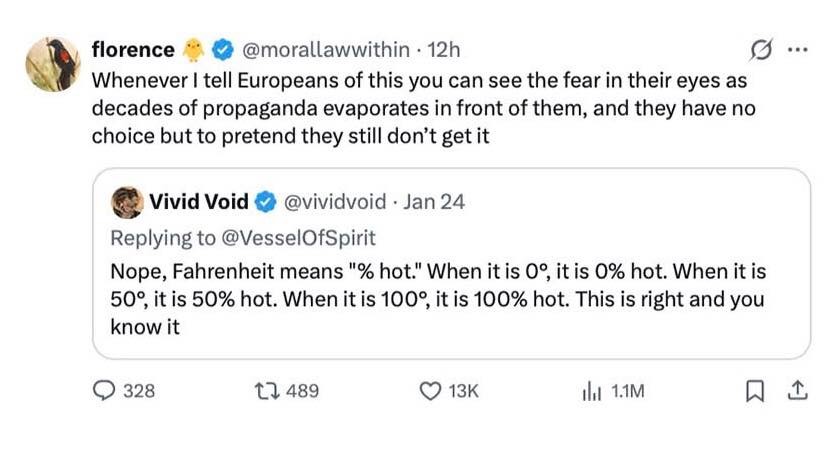
We do not know because Fahrenheit didn’t document it, and i wouldn’t be surprised if he didn’t keep track of it through his test runs either. He didn’t say which salt and how much of it in how much water, no purity indication, no nothing. He was a craftsman, not a chemist and made the scale to sell his, I concede, at the time superior thermometers. He basically vibe coded a scale in the 1700s.
But that’s all just hogwash, Fahrenheit today is literally defined through Celsius, so the US uses a metric scale but with a factor and an offset they pulled out of their ass to make it more rollercoaster like the rest of the units they like. The same as pretty much every unit they use: inch is defined through meters, pound via kilogram, just butchered for the vibes of yore. Good for them.
At this point, that’s basically every unit other than the seven fundamental units. Degrees Celsius is defined from the fundamental unit Kelvin.
Plus the actual definitions of those fundamental units were defined based on historical measurements tied to former definitions. Today the second is defined around the frequency of the cesium-133 atom, but it was traditionally measured as 1/(60 x 60 x 24) of the time of a single rotation of the earth, which stopped serving us when we realized the rotations had too much variation between days. The meter is currently defined around the speed of light and the second, but was previously defined in terms of what they thought the Earth’s circumference was, and then a metal bar they kept in Paris, then based on the wavelength of light emitted from a transition in krypton-86. Same with the kilogram, currently kept at Planck’s constant but previously based on a particular chunk of metal that was mysteriously losing mass over time, and before that defined from the density of 4°C water and the definition of the meter.
Conventions are important. The history of how we got to particular conventions can often be messy.
Shh, the non-American’s believe the US doesn’t understand metric at all and if you tell them otherwise they won’t be able to circle jerk.
If Americans actually understood metric, they wouldn’t be using a completely different system from the rest of the world in every media they produce.
Or do you think the rest of the world haven’t discovered your archaic system of temperature yet?
The same reason why the British still use miles and stone. For some other archaic units still commonly used see horsepower, nautical mile, BTUs, acres, shots (volume), and knots (speed).
Most people use the units they grew up with or use every day as their primary colloquial units. If you grew up using inch, foot, or yard, and enough people around you can also use the unit, it doesn’t change anything in your day to day to continue to use them. It also doesn’t make sense to change what you use and already know if that is also what the people around you use and already know.
That said, Americans do know metric units and many use them every day, they just don’t typically use them when talking to other Americans. If the basis of your argument is US produced media then it just goes to show you don’t really know anything about everyday US culture. Also, why would US media, made for a US audience, with US characters use a unit that most Americans don’t colloquially use?
Complaining about US media containing Imperial Units is like if I watch a Spanish movie and complain about people speaking Spanish instead of English.