
Just to put things into proportion:
This is vienna. Vienna has an area of around 400 km².

And the blue area is the area that would have to be covered by solar panels to produce enough energy for the whole city:

Source: I did the maths myself. I assumed that per person around 30 MWh of energy/year are needed. Data for this: our world in data, energy usage per person. It’s well known that 1 m² of solar panel produces around 200 Wp and that’s 200 kWh/year. So you need about 150 m² of solar cells per person. Vienna has about a million inhabitants, so that makes 150 km² of solar panels approximately.
Uhm 30MWh? That can’t be right…
In the past 5 years on average my home has used around 3.5MWh per year. We live here with two persons so that would be around 1.75MWh per person per year. Now let’s say we are very efficient and say the average person would need about 2.5MWh per year, that’s still one order of magnitude off from your number.
I can’t believe the average person in Vienna uses that much energy, especially not those living in apartment buildings.
Edit:
Ah they include everything in that graph, so the entire energy requirements of the nation divided by the population. So this includes agriculture, industry, transportation (including gas for personal vehicles) etc.
This is a pretty unfair comparison, as the people in the city would only need to generate the power for living there. Industry can have its own power sources. And in my experience many farmers have huge solar installations on top of their huge ass barns. They produce so much energy they often have their own energy infra building next to their property.
So if you include all of the energy for stuff that isn’t living, you should also include all of the surface area for stuff that isn’t living. In other words, way more than just the city itself.
And getting 100% of that energy from solar probably isn’t the best idea, it should be a mix of sources to make sure power is always available.
Yeah my reasoning was that big industrial (manufacturing, not agriculture) centers are often close to cities so the energy is consumed close to the city :) So it counts as “city consumption” to me.
Whats the total surface area of Veinna rooftops? Square footage of balconys in the city? How nearby is 150km of rural land? How windy is the surronding area?
Im betting you can get 30% there with a mix of rooftop and balcony solar. The rest of the renewable influx can be from local wind or large scale solar farms. Worst case, you build long distance, low loss DC power transmission lines to interconnext to another clean grid within 1000 miles.
Clean power is best when its very local, but it doesnt have to be. As an example, Washington state exports hydroelectric power a 1000 miles to Los angeles, California. It can be done.
EDIT:
Looking into Viennas current power, it looks to get around 60% from hydro, 6% from wind, and currently 6% from solar. Yall are at 72% renewable right now. Some random info docs also put Vienna greenspace at 40% of the city, so that means you have 240km of some kind of private or public building. Knock off 100km for errors sake, and yall may even have roughly 150km of solar area availible, right now.
If you use just 18% of it for solar roofs/balconies, you will get to 90+% renewable. At that point smile and have a glass of local wine from one of your city vineyards. You did it.
This. Leave people their balcony to enjoy, but I don’t know why we haven’t plastered solar panels on every roof in the city yet. Even if it’s not enough to push us to 100%, it’s better than nothing or are we using that space for anything else?
Im more talking about german style plugin balcony solar. The panels are normally hung off the side of the balcony and plugged into an outlet directly:
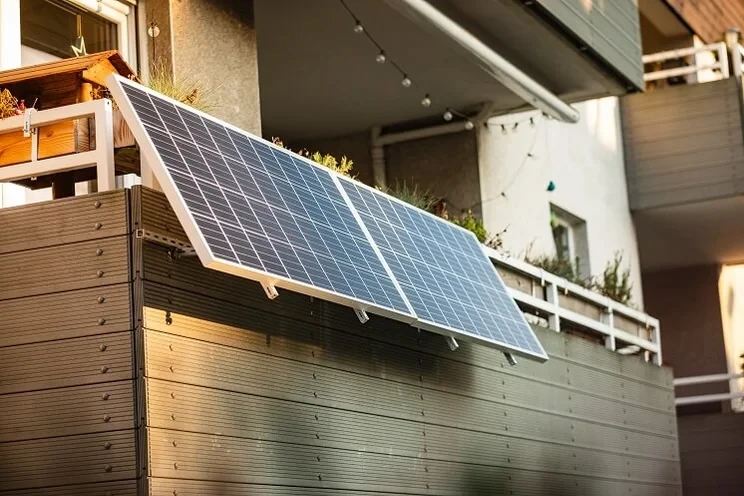
Im 100% with you on rooftop solar.
I’m not a fan of rooftop solar because it’s expensive. I remember reading it’s about twice as expensive as large-scale flat-area (“utility-scale”) solar arrays, in fact.

I would prefer it if the solar panels were installed on large-scale flat-area patches of land, close to the city. Because of cost and simplicity of maintenance. These factors matter because it makes the whole system easy-to-build and easy-to-maintain, which leads to a much faster solar energy transition, IMHO.
You gain plenty of postivies with that expense. Individual energy independence, system resilency, price stabalization, on and on. Lifespan of solar panels is 30+ years, and payback is often in the 4-7 year range. The numbers work out in your favor for a long time.
But okay, leaving out rooftop solar, and just going grid scale. With the renewable mix your city has now, and assuimg your intial power usage numbers are correct, you need 30% of the 150km to have the city running on 100% renewables. Thats 45 kilometers of nearby land. Seems way more doable than 150km, especially if its 10km here, 15km there, etc. Using a mix of agrivoltaics (farm + panels) and distressed land (old mining/industrial/military/etc) should make that even more viable.
That’s definitely a lot of solar panels!
I really don’t understand why fields are used for solar panels, instead of parking lots
Por que no los dos? In the case of germany, 60% of agricultural Land is used for feeding live stock. 10% is used for “energy plants” - With a yield ~50 times lower than an equivalent pv-area. You’d need 5% of all of the agriculturally used Land to be fitted with solar panels to fulfill the electrical energy demand of germany. It’s frankly just stupid that we don’t try to go for that.
Don’t know the numbers for austria, but i assume they are simmilar.
But his question was why not use parking lots first? It’s already dead ground for nature, has the additional advantage to keep the cars cool in the shade and the electricity is produced closer to where it’s needed.
Because putting solar panels on parking lots is more expensive than on fields. On a field you can just put stuff somewhere. For a parking lot you have to build raised platforms which have to have supports in places cars don’t have to park/drive through etc, maintenance is more expensive due to being high above ground, and construction is more complicated.
Solar panels also aren’t necessarily bad for nature, they actually help many plants and animals. Most fields weren’t always fields, but used to be forests. The partial shade introduced by the solar panels is good, because the ecosystem is still adapted to that.
To put it simply: they’re putting it in the places that are cheapest first. Once those are full or become more expensive, other places will see solar panel installations.
I commented on this in another comment: Large-scale flat-area solar parks (called “utility-scale solar”) are simply much cheaper (per kWh produced) than rooftop and parking-lot solar panels.
However, seasonal variations are a thing. You’d need a lot more in winter. June makes over 6x the power that January makes. Batteries aren’t really a total solution to that.
Check out https://pvwatts.nrel.gov/pvwatts.php
I suspect, though I don’t know for sure, that a 100% coverage of Vienna roofs is going to be close to that 400m2. Walkways, parks, roads, railways, and all that add up. Your square is over Prater, and Augarten for example, and the Danube.
yeah i know i was just trying to get a size-relation out, not to indicate that that’s exactly where they would have to be built :)
Fair enough!
In other order of words: solar energy is inefficient as it cannot be built vertically. Go fusion.
Well fusion is not ready, so in the meantime, let’s build fission, solar and wind plants to get rid of coal, oil and gas as much as possible
let’s build fission
How about not doing that and instead just building more renewables?
