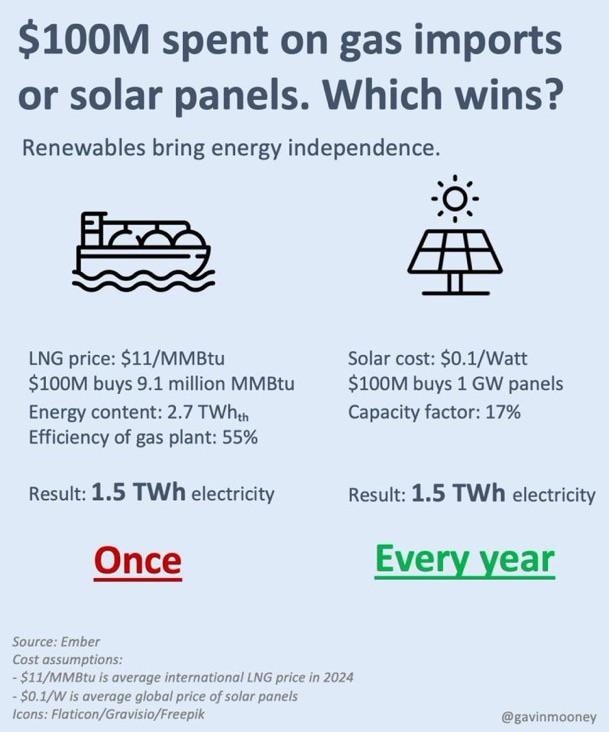
difficult to justify invading other countries though for their solar, that’s why we need to stay on oil, to prop up defence industries and provide education pathways for the poor /s
i guess you could argue too much sun falls on Iran ?
This is a climate group though and yet the economic arguments in some of these comments are bordering on insane :(
Most of the solar is produced in China, since thats who refines all the materials. So we could invade them.
difficult to justify invading other countries though for their solar
Recurring profits.
Not that difficult.
angry German energy minister noises
it can’t be used to create false scarcity! is isn’t massively volatile, how are the ultra wealthy going to make absurd amount of money off it?
deleted by creator
Not a fair comparison.
In a nutshell, you can’t directly replace gas power with electric power. Gotta have some sort of conversion. Gas is very portable and offers big bang. Solar generally needs to be generated on demand or stored. Then it needs to be transported. We can’t transport the solar power from Texas to Michigan the same way we can truck gas across state lines. The longer an electric line, the more power is lost.
Another issue with this graphic is that it implies that solar panels are a one-time expense. This isn’t true. They generally last about 20 years.
I’m a champion of green energy, but a stickler for details.
Solar panels are easily recyclable as are a lot of batteries once infrastructure catches up. You burn that gas and its gone.
Millions of acres are used for corn to produce ethanol mixes for gas. All of this land is under direct sun. Also wind. This again is because of corn subsidies in the US.
The amount of money tied up in oil companies is second only to the military industrial complex. If we took that money to put toward renewable, we would solve a shit ton of issues.
Yes voltage drop exists. However , you know we have electrical lines to basically every structure in the US right? Even Joe blow in the absolute middle of nowhere has power lines. The grid is already here. We need to invest in it and improve it (also destroy data centers but thats a different discussion)
Also, panels dont just abruptly die after 20 years. They slowly start losing efficiency. You could be using a 30 year old panel, and it could be at 70% efficiency depending on degradation (*I can’t say if 70% is accurate , I’d have to research it). Again, gas is burned up and used instantly, one time. Panel gets old, recycle it.
But we don’t do things because they’re good. We do them because they’re profitable. Capitalism breeds innovation right?
Solar panels are easily recyclable
What’s the source on this? To my knowledge they’re like most e-waste: technically recyclable but separating the component elements is functionally impossible
Most of the mass is aluminum for the frame. Then you have the actual silicon, which are paper thin wafers. And a voltage controller.
Also, its moot anyway, because that gas and oil is burned up the second its used. If we even recycle the frame of the panels only, net win.
We can’t transport the solar power from Texas to Michigan the same way we can truck gas across state lines.
Batteries?
We can’t transport the solar power from Texas to Michigan
If you’re having trouble transporting solar power to or from Texas, that may be because they’ve decided to isolate themselves from the grid.
Every other pair of places, you transport that power over the regular power network.
Also this is goofy. Panels aren’t centralized. You could have tons of panels and wind in Michigan. You wouldn’t transmit Texas power that far unless you really had to, and there’s still ways to do it if you needed
So, driving batteries around the country? Really?
Bud, we drive gas around the country. Thats even stupider.
Lot of propaganda from oil companies is working, I see.
Yeah, I know. That’s why driving electrons around the country isn’t any better.
I mean no, because it probably wouldn’t ever need to be done.
But I’m not sure why it would be any worse than trucks full of oil.
Why be just as bad as the old system? And while I’m not sure, I would expect it would be hugely more inefficient in terms of energy produced compared to energy delivered to the end user.
It wouldn’t be done because the energy density of a battery is atrocious compared to oil, something like 100x worse. Half of the input spent in burning oil comes for free in the air around us, so batteries will never likely beat it.
Then use the next $100M for developing energy storage infrastructure… Or split the upfront cost evenly between generation/storage. Gotta think longer term than a single years’s balance sheet. Anything you build now saves you money in the future instead of shoveling it into a literal incinerator.
Woah there you socialist, we only care about next quarter profits here !
/s
Wrong details though. You sound like you WANT to be dependent on fossil fuels. And calling yourself a “champion of green energy” reveals quite a lot. 🤷
Thank you for the sanity. Transmission and distribution loss is a problem, as well as sending power doesn’t even work like that. You can’t tell power where to go in a grid, you just put power in to the system. Trying to shuffle power from the Texas grid across a couple subregions to MI would be bonkers. It would be easier to operate 200 SMRs in MI.
Then as a stickler you should probably clarify that 20yrs isn’t the lifespan of a panel but the simply the end of most warranty periods.
The panel itself is (typically) fine, just less efficient after so long.
The beauty of solar though is its pretty deployable to where the demand is, especially rooftop solar with residential batteries.
Ok ok this might work but one question, can we mine solar panels out if the ground in the middle east?
There are other expenses and location also plays a big role, but it is certainly true that solar is much cheaper when all is said and done. Hence why the energy transition continues in the US even without subsidies.
my solar panels don’t produce shit because my city never sees the sun.
This is a straight up lie.
The Short Answer
Low clouds can block light from the sun, which means less solar energy. However, certain cloudy conditions can actually increase the amount of light reaching solar panels. Weather satellites such as those in the GOES-R Series keep an eye on these clouds, which can help scientists make predictions about the capture of solar energy.
https://www.nesdis.noaa.gov/about/k-12-education/atmosphere/how-do-clouds-affect-solar-energy
Do you live in Menzoberranzan?
It is blatantly not motivated by the economy (except the few vested interests).
It is mostly about power.
Okay, waiting for economics to take over then. If the markets really do work the way economists imagine then solar will become the only viable investment and power dynamics won’t matter in the end.
Look at basically any country, and installed, in use solar capacity is substantially higher than it was 10, or even 5 years ago. Solar has driven the cost of fossil fuels lower and lower. The next hurdle is utility scale batteries, which may have already exceeded 1,000 new installations per year.
good time to plug the technology connections video
How do I vote him in as president?
We need a fricken youtuber to say what the bought and paid for media is too afraid and cowardly to say. Why can we not have someone like this as a politician! Well, because he’s actually smart, he wouldn’t take that job.
When is it ever a bad time?
good time to plug the technology connections video
good time to plug the technology connections video
good time to plug the technology connections video
I missed it when it made the rounds a few weeks back. Thanks for sharing again!
I’ll take solar and geo-thermal.
I don’t know, man. What if its cloudy?
If it’s cloudy, grains don’t grow and you starve.
Me shouting the answer, but you can’t hear it over the bombs exploding across the Straight of Hormuz
Look at flowers and talk to people until it’s sunny?
You can use batterys
I mean yes, but also then the investment gets a lot bigger too.
In my country (Estonia), if we did solar + batteries only, the batteries would have to be large enough to withstand electricity consumption being smaller than production for the entire summer (which at its peak has 18 or 19 hours of sunlight per day and most people don’t have AC so our summer electricity usage is smaller than winter).
And also from about october to march, there’s almost no sunlight, and electricity consumption is through the roof because heat pumps have been pretty common in new builds and renovations for like 2 decades now, replacing mostly solid fuel furnaces rather than resistive electric heaters.
Which is not to say we should abandon solar, but it’d be incredibly cost-prohibitive to go renewables-only here. In the summer our electricity prices often go negative already (still zero + network fees for consumers, not really negative prices -.-), but in winter I’ve seen 5 euros per kilowatthour at peak times.
Now I googled the cost of a terawatt hour of battery capacity and Google’s AI was happy to report to me that a terawatthour is a million kilowatt hours and thus at ~80€/kWh it would be 80 million euros. That’s peanuts! Just 640 million would get us enough battery capacity to store a year’s worth of energy, that should surely get through a winter!
Trouble is, I was taught slightly different values for the SI prefixes and back when I went to school, tera was a billion kilos. So if it still functions that way, we’re talking hundreds of billions instead. Our national budget for the year is 20 billion. But if every person with a job paid just a million extra euros in tax, we could afford to do it!
So obviously, solar alone + batteries won’t do it at such a high latitude. Wind power helps a ton, but that’s still unpredictable. And after everyone on a flexible-price plan saw a 5x increase on their power bill for january (1000+ euros being pretty common), I don’t think the people will settle for “works most of the time”. We actually need a nuclear power plant and we need it to be built before December 2025.
Till then we’ll continue burning dirty ass coal and (yay, even worse) shale. Which I fucking hate, but the economic reality of our country is that this is what we can afford right now, with a gradual buildout of solar + wind.
But funnily enough, if we got the hundreds of billions worth of batteries magically out of thin air, the cost of buying enough solar panels to produce the entire country’s annual electricity consumption every year… Would be in the hundreds of millions range or a bit over a billion at most if this meme/infographic is to be believed, even if adjusting the capacity factor, which is more like 10-15% here due to our nasty winter. Chump change pretty much for a country like ours.
This is the funny AI response that says both millions and billions for the cost of a terawatt hour of battery capacity. For my own calculations I actually went to the source at Bloomberg and took a number that was on the lower side, but not the minimum, of the range they provided for 2024.

I don’t think we have to worry about AI developing the I part of AI anytime soon.
Also, in 2024 we roughly doubled our peak solar output from 600 MW to 1300 MW! (2025 unfortunately saw a LOT less new solar installation).
But our winter peak consumption is 1600 GW, so this is still a bit under 0.1% of that. And peak production is in the summer :/
Trouble is, I was taught slightly different values for the SI prefixes and back when I went to school, tera was a billion kilos. So if it still functions that way, we’re talking hundreds of billions instead. Our national budget for the year is 20 billion. But if every person with a job paid just a million extra euros in tax, we could afford to do it!
Not sure if you were taught wrong or misremembering, but giga is the standard notation for billion, and tera is trillion. Kilo, mega, giga, tera,
quad, quin, peta, exa… They go on much farther than that, but at that point, just use exponential notation.E: wrong notation form
If tera is trillion and kilo is thousand, tera is a billion times kilo.
I don’t remember quad or quin, we had peta and exa here.
Derp, I knew that too.
You can generate hydrogen from electrolysis.
Electrolysis efficiency is about 70% and you can store the hydrogen in pressurized underground caverns for a year or longer using another 0.12 kWh per kWh of hydrogen stored, which makes a total efficiency of around 0.6 kWh of hydrogen generation and storage for every kWh of electricity that you put in. (Source)
So if your electricity costs 6 ct/kWh (current LCOE of solar in many places), then hydrogen is gonna cost 10 ct/kWh to generate and store with current technology.
Currently, natural gas is around 5 ct/kWh, so solar would have to become a little bit cheaper to make it economically competitive.
Edit: to clarify, the 5 ct/kWh for natural gas is the gas alone; electricity from natural gas is more expensive than that (around 12 ct/kWh) and more expensive than solar.
What are you going to store hydrogen in to make this remotely viable? You lose like 60% of hydrogen within 7 days with current tanks and seals.
The new sodium batteries make this completely pointless from a cost and efficiency context
Hydrogen can be stored for years.
is home hydrogen a thing? i was wondering before, if it works in cars, why is it not in houses?
hydrogen scales well if you use big industrial setups, both for generation and for storage.
basically, bigger tanks are cheaper (consider higher volume/surface area ratio) and in fact the best tanks might simply be naturally occurring underground caverns. you can’t have these at home.
There’s a engineer that did it in his backyard. I’ll see if I can find it when I get home.
Technically it could work. However, traditional batteries make a lot more sense. Hydrogen makes some sense for a vehicle because it can be more energy dense (it actually only makes sense for large trucks). However, it has to be stored at cryogenic temperatures. In a place where you probably don’t care about mass or space much, other battery technologies are far better, without the added cost of cryogenic cooling and having to deal with hydrogen, which leaks through anything.
You would store it as a pressurized gas in this scenario. You would only use liquid hydrogen in specific situations.
Hydrogen gas is really hard to store. It is tiny, so it’s basically always leaking, no matter how good your seal is.
Underground caverns can store it for years. This is simply not true.
That sounds cheaper than battery storage (which at latitudes bigger than yours can get very expensive since there’s little to no sun in the winter), and I’d assume more environmentally friendly than mining all that lithium as well.
How expensive is it to build out said caverns for this use, particularly if there aren’t many natural ones available?
basically the caverns that are being considered/used for this are the same caverns that natural gas was extracted out of in the first place … they clearly held some sort of gas fine for millions of years, so certainly they’re gonna store a bit of hydrogen too.
they clearly held some sort of gas fine for millions of years, so certainly they’re gonna store a bit of hydrogen too.
Not to rain on your parade, but hydrogen and natural gas aren’t really comparable for storage. The natgas molecule is 8x heavier and MUCH larger than a molecule of hydrogen. Just on the size alone, hydrogen can slip through just about everything and needs to be stored at cryogenic temperatures. I don’t think rock is going to be as good of a storage media as you’d assume.
Oh that makes sense.
We just don’t have any natural gas production in Estonia lol. Perhaps the shale mines could be used. Unfortunately the biggest one had its permit extended till 2049 recently. Also I think they get filled with water naturally (they pump out a lot of dirty water), so I suppose the walls aren’t actually completely sealed naturally.
yeah, geological availability might vary
And with battery prices falling, the intermittency issues that made LNG useful despite the drawbacks is gradually becoming much less of a problem too.
Plus it’s pretty easy to simply shift the time of use to when there’s the most clean capacity online (and this is easily encouraged with variable electricity rates)
I’m solar fan #1, but 5x that price would still be a good deal on panels
When our energy department ran this calc Solar was far cheaper but the actual costs were nearly 10x using LPG because a grid needed storage and diversification to account for the different outputs. If the sun is low you cant run a country of batteries and still have it match LPG.
This image shows Solar at a best case comparison and not the times when its producing 20% of LPG
Maybe there’s a battery somewhere in there?
And this is 2024 numbers. Gas is more expensive now that the strait of Hormuz is closed for a good long time
This is dead wrong (edit: kind of; see below). The dollars per million BTU for natural gas this February was $3.62, or 32% of the figure cited in the infographic. You’re thinking of oil.
Solar is clearly more sustainable, economical, independent, and most importantly livable than LNG, but I still need to call out flawed assumptions on my side where I see them.
Edit: I actually have no idea how this infographic reached its $11 assumption. Wholesale prices for natural gas were $4.88 per MMBtu in 2024. Emphasis on “wholesale”, but since this infographic doesn’t deign to cite any sources other than “Ember” (this Ember?), I have no idea what figure it means.
Edit 2: After doing way too much digging into how global LNG prices are measured because this infographic barely even leaves breadcrumbs, they might’ve been using a metric like the JKMc1 (“LNG Japan/Korea Marker PLATTS Future”) (edit 3: or the TFAc1). The prices of natural gas (transported via pipeline) and LNG (transported via ship) are going to be quite different, and there’s no consistent “global average price” for LNG. The best you can really do is use some sort of proxy, for which it appears the JKMc1 is a reasonable one for reasons I don’t fully understand yet. That was approximately $11 in 2024 (it was actually seemingly higher, but close enough; probably close but separate figures) and was $10.73 this February. It was $15.92 March 1, showing at least in East Asia that LNG is about 50% more expensive than last month. I don’t know how well that applies to Lemmy’s predominantly American and European userbase, however (well, I know the US now supplies about 60% of Europe’s LNG and that American natural gas is currently cheaper).
God, it’s so frustrating that this infographic barely cites anything. Anyway, to the person I responded to: you were at least somewhat right; the closing of the Strait seems to have clearly impacted East Asia… somehow. Iran and Qatar are the 3rd and 6th largest natural gas producers, respectively (no clue about LNG shipments), but I feel like I’ll end up with a doctoral thesis on the geopolitics of LNG prices by 2030 from knowing basically nothing if I don’t stop here. What all this does tell me is that an estimate of “global average price for LNG” means very little when prices per MMBtu (liquified or otherwise) seem to vary so heavily by region.
this right here is the only reason I’m still skeptical of pretty much everything
promoters of green and nuclear energy can’t get their damn act together and create proper articles that aren’t half-assed crap with no sources. They just claim shit from thin air.
Bitch, I WANT to believe you! Give me something to bloody believe that we really have no reason to use fossil fuels anymore.
I still
kindabelieve it. But CONVINCE ME ALREADY…It’s funny you assume they have to convince you.
We know already about climate change, we know already about geopolitics and sovereignty issues, we know fossil fuels are a finite resource, which means they’ll inevitably get more expensive over time as we run through the most accessible deposit and go to ones that are harder and harder to harvest.
But you think they should convince you to use renewable, and not the other way around: why would you want to stick to fossil fuels? Name your argument and back it with solid sources, please!
I don’t have one and I’m in favor of every renewable + nuclear
I think using fossil fuels increases dependence on other countries like the
southmiddle east, which both causes instability in those regions, and makes us vulnerable to them.Though you are right about how fossil fuels will become more expensive eventually, we’ve been finding more coal and oil deposits than we have been depleting… At least according to like an hour of research I did a while ago. It’s close, but I don’t think we will be running out soon.
Though the ozone layer is healing specifically because we cut back on that shit.
My point was - why fucking make shit up and lie in favor of renewables and nuclear? Why not quote proper sources? There’s plenty of positives to renewables but man, some of these writers are incompetent.
In Yankee places “gas” means “gasoline” so I’d blame the infographic for saying “gas imports” instead of “natural gas imports” if it’s supposed to target the country that uses the most natural gas
I don’t blame it whatsoever for calling it “gas”; it should be clear to anyone remotely familiar enough with energy infrastructure to understand anything past “solar better”, i.e. they should at least pick up on one of the following (in no particular order):
- Gasoline and solar power would only be comparable for cars, and the comparison would be nonsense because electric cars pull from the grid, not pure solar.
- The icon on the left is distinctly an LNG tanker. Even if you’ve never seen one, anyone who’s seen a crude oil tanker would know it looks nothing like that.
- The graphic explicitly says “LNG” twice.
- Measuring gasoline in MMBtu would be deranged for this comparison; the sale price is expressed in the volume of crude oil/gasoline, so you’d just convert it straight to Watts. Even if you didn’t know what a Btu is, you’d at least think “what the fuck is an MMBtu?”
- Cars are never mentioned once.
- One of the statistics is “Efficiency of a gas plant”, which is the nail in the coffin for anyone who understands literally anything about energy.
At some point it’s incumbent on the reader to have a bare minimum understanding of how the world around them works; I learned some of this in circa sixth grade. Some of this on its own isn’t common knowledge; all of this taken together should stop any reasonable reader from defaulting to “gasoline”.
If you’re just gleaning it in a hurry, you miss the relatively fine print from “LNG” to “55%”. Selecting font sizes to emphasize the most important information, and being understandable by an uninformed audience base (think social media), is absolutely fundamental to infographics.
the comparison would be nonsense because electric cars pull from the grid, not pure solar.
Not necessarily. Quite a lot of solar installation companies like Tesla’s popular roof-like tiles push self-sufficiency for some reason. My guess is to sell batteries. Anyways, even without that, your petrol bill’s still a useful visualization for how much more economic solar is
anyone who’s seen a crude oil tanker
MMBtu
gas plant
Buddy, I obviously agree for MMBtu, which is why I cited it among other unordered points and explicitly called out that people are liable not to know it. If you do know it, though, it immediately gives it away, which is why I included it to cover bases.
But a crude oil tanker is a common thing plenty of people have seen, and putting “power plant” in there is straight-up a self-own: you are profoundly ignorant about energy infrastructure if you think we’re taking gasoline into power plants to convert into electricity. That doesn’t make someone bad or stupid; it just means they have zero standing to complain about how an energy infographic misled them by calling methane “gas”. They lack the bare minimum foundation to even understand what it’s trying to say.
It should also be obvious that when I said “not pure solar”, I meant “generally”, because at that point the reader would need to be willfully obtuse to construe the graphic to be about electric cars. I almost hedged with “generally”, but I (wrongly, naïvely) assumed it wouldn’t be subjected to superfluous pedantry.
Edit: I actually forgot another obvious point because there are just so many things that would tell reasonable people this isn’t about gasoline: why would a tanker be used as an icon to represent gasoline anyway? A jerrycan, an oil barrel, or a gas pump would clearly be much better, because oil tankers don’t represent the final product anyway, aren’t a common icon for gasoline (if basically at all), and don’t have a distinctive side profile. There are a million reasons it’s not the graphic’s fault if you look at it and assume it’s about gasoline.
Not everyone lives in oceanside windows. Out of those who have looked at one they don’t necessarily know that’s an oil tanker; if it’s through a beach, it’s too distant (and likely heatwaved) to perceive something different with the deck at first sight, and at closer ranges I used to think they were just empty cargo ships “and of course the decks are so high up because the ship is floating higher up because it’s lighter”. Working with content who’ve never been on a ship they think there’s nothing beneath the deck except what makes it float.
There’s also the assumption that one wouldn’t think “it’s probably a different kind of oil tanker I haven’t seen since it ‘obviously’ says gasoline”. “What the fuck is an MMBtu?” Something related to gasoline, of course. Hindsight is not first sight.
Most US people are profoundly ignorant about energy infrastructure other than coal plants exist and the US relies on fossil fuels and you put petrol in your car. Just because you remember a great education doesn’t mean others remember their bad education. Ask someone outside of the energy and environmental subject what they learned in Earth Science (sorry if I got the subject name wrong) other than the different types of rocks, tectonics, and what the weather really is.
it just means they have zero standing to complain
An infographic’s purpose is to communicate to the uninitiated, not preach to the choir. This is just a single word that artificially limits its target audience and frankly I don’t see why we’re arguing so pointedly about it.
the reader would need to be willfully obtuse to construe the graphic to be about electric cars
I didn’t think it was about cars either, but I still think it’s plausible enough that one in a hundred could mistake it, and that is my point.
P.S.: Kudos for the diaeresis.
It’s probably just AI generated bs.
Generally, solar takes 10+ years to break even in a residential situation, I can’t see how things would be 10x cheaper at the TWh scale.
I don’t agree with the “AI-generated” claim. Gavin Mooney appears to be a real person working with Kaluza, an Australian company which presents itself as:
The Energy Intelligence Platform
An electrified future will be built on data intelligence.
We turn energy complexity into growth opportunity so energy companies can make a cleaner, smarter system work for everyone.
(So a financial conflict of interest, but one I happen to agree with.) I just attribute it to a “shitty, token attempt at sourcing because nobody really checks these things” mindset.
When energy prices went crazy in the UK a while back I heard of some people getting under a year payback times. My energy usage is much lower than theirs so it would take me quite a bit longer though. A lot of the costs are fairly static.
At this point a battery alone might be a better investment. Cheaper install and using off peak rates to charge could drop my per unit costs from 24 to 8. But I think even that would take years to pay for myself. It’s also annoying because the grid should already be fucking doing this! Why should I have to do it myself in a setup that is going to be far less efficient in costs than doing it at grid scales with bulk buying of batteries?
The tech exists today, I can buy it.
For DYI plug-in small scale solar and meter running backwards (balkonkraftwerk scenario) for 0.3 eur/kWh break even is less than 2 years.
DYI larger/meter not running backwards but with battery buffering it’s longer. Anything else requires a licensed electrician, and that does set you back.
Economies of scale
Maybe.
I can’t find any gavinmooney profiles on any socials… even x dot com.